Legionbound Turns Chaos Into a Surprisingly Addictive Little Army Builder
This retro-styled autobattler blends roguelite progression, class synergies, and gloriously silly number inflation into a low-cost time sink that is easy to pick up and weirdly hard to put down, even when the battlefield starts looking like a spreadsheet caught fire.
last updated Jun 08, 2026
For players who love watching builds snowball into beautiful nonsense, this is a small-team gem.
A Legion That Mostly Builds Itself
Legionbound knows exactly what kind of game it wants to be, and thankfully it does not pretend otherwise. This is an autobattler with one foot in idle design and the other in light roguelite structure, asking you to recruit heroes, arrange a growing formation, trigger class synergies, and eventually fuse units into stronger Ascensions. The core loop is immediately readable, which gives it a welcoming rhythm even for players who do not normally live inside menus and meta trees. What gives it staying power is the steady drip of new combinations, subclass interactions, and build experimentation that keeps each run feeling just different enough. It is the kind of game that can happily sit on a second monitor, yet it still leaves enough room for active tinkering when you want to steer the chaos rather than simply admire it.
Synergies, Ascensions, and the Joy of Making a Mess on Purpose
The best part of Legionbound is how often it rewards curiosity. Mixing classes into synergy heroes and then folding those into Ascensions creates a satisfying sense of discovery, and the roster feels broad enough that experimenting rarely feels wasted. There is a real pleasure in finding a combination that suddenly clicks and watching a previously ordinary army transform into an absurd rolling disaster for anything on the other side of the screen. The skill tree and keystone-style choices also add welcome personalization, giving runs a bit more identity than the genre sometimes manages. That said, some of the deeper systems can feel opaque, and the game is not always great at explaining why one hero is carrying the team while another, on paper, should have been the star. Even so, the toybox is generous, and for a small-team project at this price, the amount of buildable nonsense on offer is honestly hard not to admire.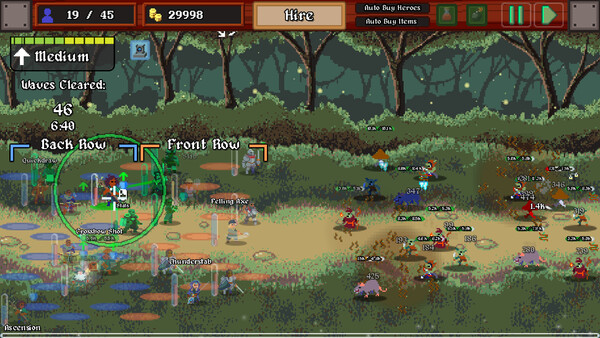
When Casual Becomes Chaotic
Legionbound works best when approached as a flexible experience rather than a strict strategy exam. It can be relaxed and almost meditative, but it can also become visually frantic once armies swell and effects start stacking over one another like the game is trying to win an argument through particle density alone. In the early and midgame, that energy feels lively and satisfying, especially when spells, passives, and positioning all contribute to keeping the machine humming. Later on, though, common friction points start to show, with battles becoming cluttered enough that tracking individual contributions is difficult and certain menu conveniences feeling overdue. A few interface limitations, like wanting clearer information on hero performance or better previews for Ascensions, make the game feel slightly rougher than its ideas deserve. Even with that, the underlying loop remains strong because the act of expanding a humble squad into a ridiculous wall of stats is fundamentally compelling.
Pixels, Performance, and Productive Visual Overload
Visually, Legionbound lands in that sweet spot of simple but appealing. The pixel art is clean, readable in smaller encounters, and loaded with enough charm to give the game personality without overcomplicating its presentation. It is not chasing lavish spectacle, but it does not need to, because the real visual payoff comes from seeing dozens of heroes, enemies, numbers, and effects pile into a battlefield that gradually resembles an arcade cabinet having a nervous breakdown. The problem is that this escalating spectacle can come at a cost. Screen clutter is a recurring issue in later stages, and performance instability appears often enough at high unit counts or faster settings to be worth noting, with crashes and freezing reported as the chaos peaks. For most of the journey it runs light and breezy, but the endgame can push things from energetic to strained in a hurry.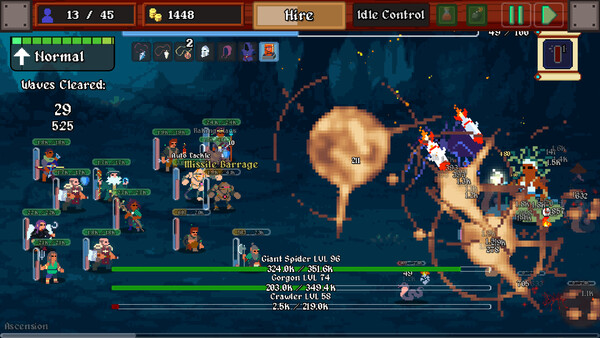
The Soundtrack of Numbers Going Up
Audio is one of the game’s quieter strengths, which feels appropriate for something that can so easily become a background obsession. The soundtrack has a pleasant, motivating pulse to it, helping each mode maintain momentum without becoming intrusive, and several of the stage themes do a lot to keep longer sessions from blurring together. Sound effects also do useful work in the middle of the visual noise, offering cues that help combat retain some structure even when the battlefield becomes a storm of overlapping actions. That matters more than it might seem, because a game like this lives or dies on whether its chaos feels satisfying or merely messy. Legionbound usually lands on the satisfying side, with audio helping to make sense of its busiest moments. It may not be the sort of soundtrack you immediately sprint to add to a playlist, but in play it absolutely pulls its weight.
STEAM RATING
Developer
Spicy Garlic Games
Publisher
Gamersky Games, Spicy Garlic Games
Release Date
April 27, 2026
Verdict & Summary
Legionbound is a scrappy, smartly designed indie autobattler that understands the appeal of low-friction progression and then stuffs that formula with enough class combinations, Ascensions, and replayable modes to keep the grind feeling lively for far longer than its modest price suggests. Its greatest strength is the way it balances chill idling with active build tinkering, letting it work as both a comfort game and a light strategy sandbox depending on your mood. The rough edges are real, with cluttered late-game battles, uneven clarity in some systems, and performance issues cropping up once the action gets especially dense, but none of that erases how easy it is to get hooked on its loop. For players who love watching builds snowball into beautiful nonsense, this is a small-team gem that delivers a lot of value and a lot of accidental lost evenings. It is not the deepest autobattler on the market, but it is one of the more charmingly compulsive ones, and sometimes that is exactly the assignment.